20.Aug.2026
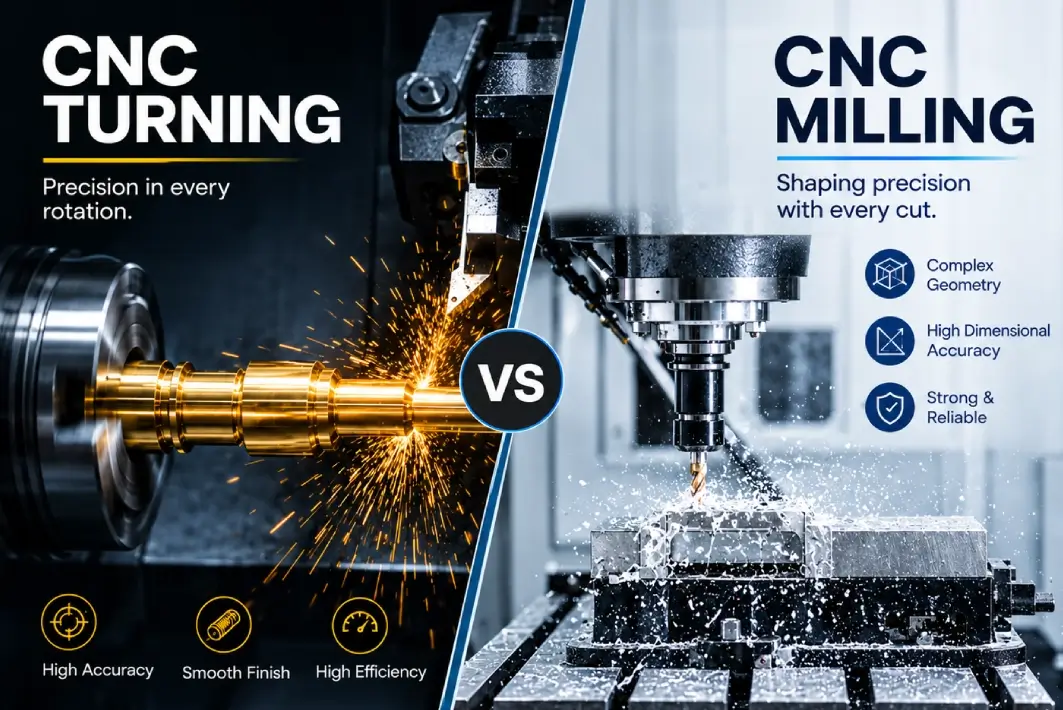
In today's precision manufacturing industry, selecting the right machining process is critical to achieving the desired performance, accuracy, and cost-efficiency. Two of the most used machining methods are CNC Turning and CNC Milling. While both processes use Computer Numerical Control (CNC) technology to manufacture high-precision components, they are designed for different part geometries and applications.
Understanding the difference between CNC turned parts and CNC milled parts helps engineers, procurement teams, and manufacturers choose the most suitable manufacturing process for their projects.
CNC turning is a machining process where the workpiece rotates while a stationary cutting tool removes material to create the desired shape. This process is performed on CNC lathes and is ideal for manufacturing cylindrical or rotational components with high accuracy.
CNC milling uses rotating cutting tools while the workpiece remains fixed. The cutting tool moves across multiple axis to remove material, allowing manufacturers to produce complex geometries that cannot be achieved through turning alone.
| S. No. | Feature | CNC Turned Parts | CNC Milled Parts |
|---|---|---|---|
| 1 | Workpiece Movement | Rotates | Stationary |
| 2 | Tool Movement | Stationary or Linear | Rotating Cutting Tool |
| 3 | Best For | Cylindrical Parts | Complex & Prismatic Parts |
| 4 | Typical Machine | CNC Lathe | CNC Milling Machine |
| 5 | Speed | Faster for round components | Better for complex designs |
| 6 | Cost | More economical for rotational parts | Higher for intricate geometries |
| 7 | Surface Features | Threads, Grooves, Cylinders | Slots, Pockets, Contours, Flat Surfaces |
Both CNC turning and CNC milling deliver excellent precision when performed using modern CNC equipment.
Generally:
The choice depends entirely on the geometry of the component rather than which process is "better."
CNC turned components are widely used across industries that require durable, high-performance rotational parts.
These include:
CNC milled components are commonly found in:
Absolutely.
Many precision-engineered components require both turning and milling operations.
For example:
Combining both processes reduces setup time, improves accuracy, and minimizes production costs for complex components.
Advancement in technology has led to development of CNC Turn Mill machines which integrate CNC Turning and CNC Milling operations in one machine and are invariably useful in processing of components where movement from one machine to another leads to loss of GD&T accuracy needs.
Consider the following factors before selecting a machining process:
At Ramco Steels, we combine advanced manufacturing technology with decades of engineering expertise to deliver high-quality CNC machined components for global industries.
Our manufacturing capabilities include:
We manufacture precision components for:
Whether you require CNC turned components, CNC milled parts, or fully machined assemblies, Ramco Steels delivers reliable quality, consistent precision, and on-time delivery.
Both CNC turning and CNC milling are essential manufacturing processes, each serving different engineering requirements. CNC turning excels at producing precise cylindrical components efficiently, while CNC milling is the preferred choice for complex, multi-dimensional parts.
Choosing the right process depends on your component's design, material, tolerance requirements, and production volume. For many advanced applications, combining both machining methods provides the optimal solution.
With world-class infrastructure, experienced engineers, and integrated manufacturing capabilities, Ramco Steels is your trusted partner for high-precision CNC machined components across diverse industries.



Corporate Office
Plot No. 75, Sector 25,