31.Jul.2026
In today's competitive manufacturing landscape, precision is more than just a quality benchmark—it's a business necessity. Industries such as automotive, aerospace, energy, hydraulics, medical equipment, and industrial machinery depend on components that fit perfectly and perform consistently. Even the smallest dimensional variation can affect assembly, efficiency, safety, and product lifespan.
This is where tight tolerance CNC turning becomes critical. By producing components within extremely narrow dimensional limits, manufacturers ensure every part performs exactly as intended, reducing failures and improving reliability. Modern CNC turning centres can achieve tolerances measured in microns when supported by the right equipment, tooling, and quality control.
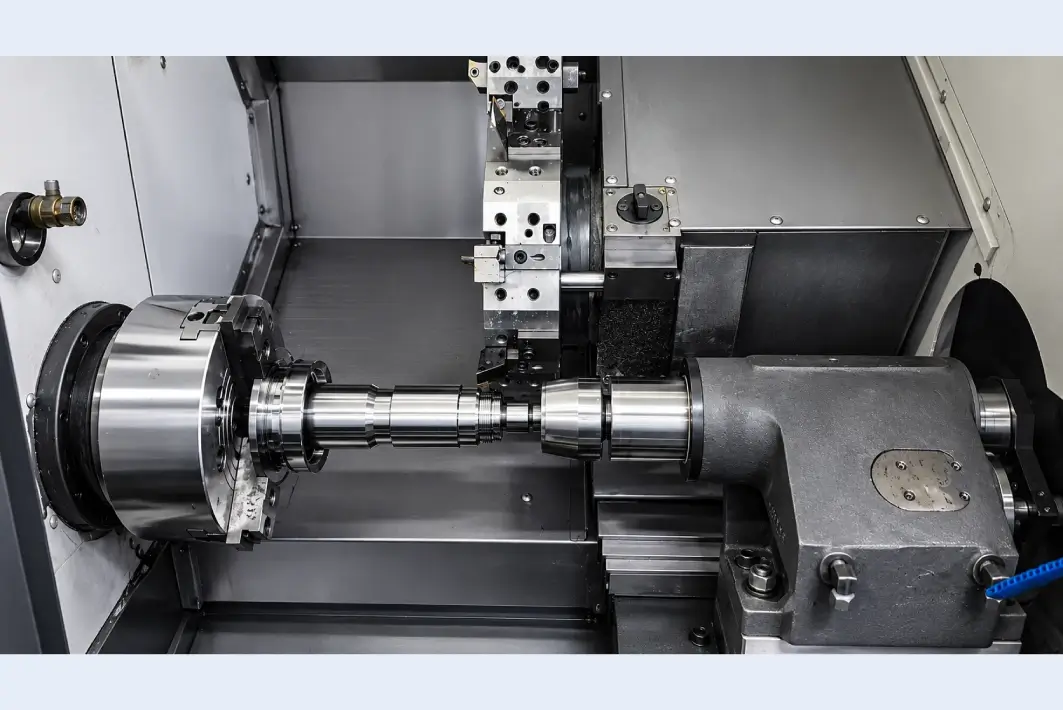
CNC turning is a precision machining process in which a rotating workpiece is shaped using computer-controlled cutting tools. Tight tolerance CNC turning refers to machining parts with extremely precise dimensional accuracy, often requiring tolerances significantly tighter than standard machining practices. Standard CNC turning can generally hold tolerances of +/- 0.025 mm to +/- 0.12 mm. "Tight Tolerance" turning refers to dimensions held within +/-0.005 mm to +/-0.020 mm (or +/-0.0002 to +/-0.0008 inches).
These precision requirements are typically specified for:
The exact tolerance depends on the application, material, and functional requirements of the component. Engineers should specify only the tolerances needed for performance, as unnecessarily tight tolerances increase machining time, inspection effort, and manufacturing cost.
Many assemblies contain multiple precision-machined parts. Even a slight dimensional variation can lead to:
Tight tolerance machining ensures every component fits exactly as designed.
Precision-manufactured parts experience:
This improves overall equipment reliability while minimizing maintenance costs.
Industries that demand tight tolerance components include:
These sectors rely on precision because component failure can compromise safety, performance, and operational efficiency.
Achieving high precision requires more than advanced machinery. Several factors directly affect machining accuracy:
High-performance CNC turning centres minimize vibration and thermal distortion for consistent machining accuracy.
Premium carbide inserts and precision tooling reduce tool wear while maintaining dimensional consistency.
Different materials behave differently during machining. High-quality raw materials improve consistency and reduce dimensional variation.
Heat generated during machining can cause slight expansion of both the workpiece and cutting tool. Controlled machining environments help maintain dimensional stability.
Optimized CNC programs improve:
The right programming ensures precision without sacrificing productivity.
Producing precision parts is only half the process. Comprehensive inspection verifies that every component meets the required specifications.
Quality control typically includes:
These inspection methods ensure every part conforms to customer drawings before shipment.
Precision CNC turned components are widely used in:
These parts often operate under high stress, making dimensional accuracy essential for dependable performance.
Working with an experienced precision machining manufacturer offers several advantages:
A capable manufacturing partner also helps optimize designs for manufacturability, balancing precision requirements with production efficiency.
At Ramco Steels, precision is built into every stage of manufacturing. Our advanced CNC turning capabilities are supported by experienced engineers, stringent quality control, achieved with the help of world class metrology and effective use of 7QC tools and a commitment to delivering components that meet demanding industry standards.
We manufacture high-quality CNC turned parts for industries requiring exceptional dimensional accuracy, durability, and repeatability.
Our capabilities include:
Whether you need standard components or complex custom parts, Ramco Steels delivers precision-engineered solutions that perform reliably in the most demanding applications.
Tight tolerance CNC turning is not simply about achieving smaller numbers on a drawing—it is about ensuring flawless assembly, reliable performance, and long-term durability. As industries continue to demand higher precision and consistency, manufacturers that invest in advanced machining technologies and rigorous quality control gain a significant competitive advantage.
Choosing an experienced precision manufacturing partner like Ramco Steels ensures your components meet exact specifications while maintaining efficiency, consistency, and superior quality across every production batch.
A tight tolerance generally refers to machining parts with very small allowable dimensional variation. The exact value depends on the application, material, and design requirements.
Automotive, aerospace, medical, oil & gas, industrial machinery, power generation, hydraulics, and precision engineering industries commonly require tight tolerance components.
They ensure proper fit, reduce assembly issues, improve product reliability, minimize wear, and enhance overall equipment performance.
Yes. Achieving tighter tolerances often requires slower machining, specialized tooling, additional inspection, and stricter process control. Therefore, tolerances should match functional requirements rather than being tighter than necessary.
Common materials include carbon steel, alloy steel, stainless steel, brass, aluminium, copper, titanium, and engineering plastics, depending on the application.



Corporate Office
Plot No. 75, Sector 25,