

27.Oct.2026
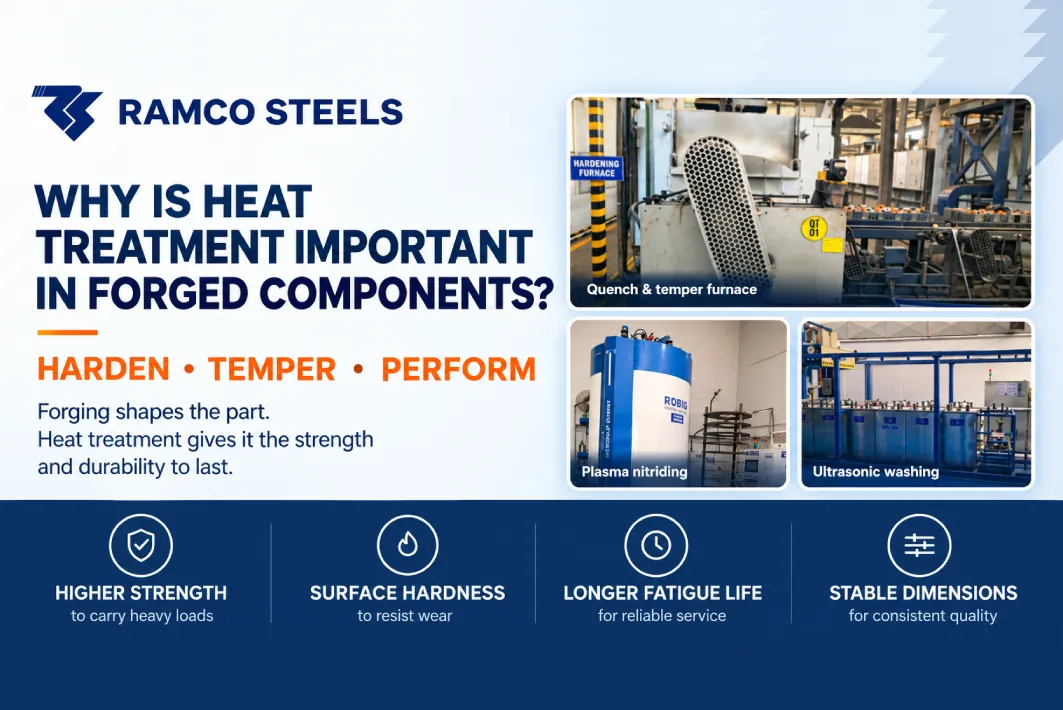
Heat treatment plays a vital role in improving the mechanical properties, durability, and performance of forged steel components. Although forging gives metal its desired shape and can improve its grain structure, the process may also introduce residual stresses, non-uniform microstructures, and variations in hardness. Suitable heat treatment processes help address these challenges and ensure that components meet the required performance specifications.
Processes such as normalizing, quenching and tempering, stress relieving, and plasma nitriding are widely used to improve the properties of steel components for demanding industrial applications.
Heat Treatment involves controlled heating and cooling of metal to achieve specific mechanical and metallurgical properties. Selecting the appropriate process depends on the steel grade, component geometry, required properties, and intended service conditions.
Forged components often require specific levels of hardness, tensile strength, yield strength, elongation, and toughness. Heat treatment processes such as normalizing, quenching and tempering help achieve these properties according to the component's application.
For example, quenching and tempering can increase the strength and hardness of steel while maintaining the toughness needed to withstand mechanical loads and impact.
Forging involves significant plastic deformation and exposure to elevated temperatures. Depending on the forging conditions, steel may develop variations in grain size and microstructure.
Appropriate heat treatment can refine the grain structure, improve microstructural uniformity, and help achieve more consistent mechanical properties throughout the component.
Machining forged components can be challenging when the material has excessive hardness or inconsistent mechanical properties. A suitable heat treatment process can establish a more machinable condition, depending on the steel grade and machining requirements.
Improved machinability can reduce cutting tool wear, extend tool life, improve surface finish, and support more consistent manufacturing results.
Forging, uneven cooling, and subsequent machining can introduce or redistribute residual stresses within a component. These stresses may contribute to dimensional changes or distortion during machining and service.
Stress relieving and other suitable heat treatment processes can reduce residual stresses and improve dimensional stability. However, the results depend on the material, component design, and selected heat treatment cycle.
Quenching and tempering is a widely used heat treatment process for steel components that require a combination of strength, hardness, toughness, and resistance to mechanical failure.
The process consists of three main stages: austenitizing, quenching, and tempering.
Steel is heated to a temperature appropriate for its grade, generally above its critical transformation temperature, to form austenite. The required temperature and holding time depend on the steel's chemical composition, component thickness, and specified heat treatment procedure.
Proper heating helps establish the desired structure before quenching.
After austenitizing, the steel is rapidly cooled using a suitable quenching medium, such as water, oil, or polymer solution.
When the steel's hardenability and cooling rate are sufficient, austenite transforms into martensite, a hard microstructure that significantly increases hardness and strength.
However, rapid cooling also creates thermal and transformation stresses, increasing the risk of cracking and distortion if the process is not properly controlled.
After quenching, the steel is reheated to a selected temperature below its lower critical transformation temperature, held for a specified duration, and then cooled under controlled conditions.
Tempering reduces the brittleness and internal stresses associated with as-quenched martensite while improving toughness. Hardness generally decreases to a controlled level, allowing the component to achieve the required balance of strength, hardness, and toughness.
The result: Quenched and tempered steel components can offer reliable mechanical performance when the heat treatment parameters are selected according to the material grade and application requirements.
While conventional heat treatment processes can improve the properties of a component throughout its structure, some applications also require enhanced surface performance. Plasma nitriding is a thermochemical surface-hardening process used to improve surface hardness, wear resistance, fatigue performance, and service life in suitable steel components.
Also known as ion nitriding or glow-discharge nitriding, plasma nitriding introduces nitrogen into the surface of steel using a controlled plasma environment.
The process is typically carried out in a vacuum furnace using nitrogen and hydrogen gases at temperatures commonly ranging from approximately 450°C to 550°C. Treatment duration may range from around 12 to 30 hours, depending on the material, required surface hardness, effective case depth, and specified compound-layer or white-layer characteristics.
The actual parameters must be established for the component and its material grade.
The process generally involves four stages:
Components are loaded into the furnace, and air is removed to establish the required low-pressure environment. This creates suitable conditions for the plasma nitriding process.
The components are heated to the specified process temperature. An electrical discharge generates plasma, and sputtering helps clean and activate the component surfaces before nitrogen diffusion begins.
Nitrogen enters the steel surface and interacts with suitable alloying elements, forming nitrides and creating a hardened surface region. Depending on the material and process parameters, a compound layer and an underlying diffusion zone may develop.
These layers contribute to surface hardness and wear resistance, while the component's core can retain the properties established by earlier heat treatment.
After the required treatment duration, the components are cooled according to the approved process cycle, often within the controlled furnace environment.
Proper cooling helps maintain the desired surface condition and supports dimensional stability.
Although both processes improve steel component performance, they serve different purposes.
| Feature | Quenching and Tempering | Plasma Nitriding |
|---|---|---|
| Primary purpose | Improve bulk strength, hardness, and toughness | Improve surface hardness and wear resistance |
| Main mechanism | Austenitizing, rapid cooling, and tempering | Nitrogen diffusion and nitride formation |
| Typical temperature range | Depends on the steel grade and treatment cycle | Approximately 450°C–550°C |
| Main area affected | A substantial portion of the component's cross-section | Primarily the surface and subsurface region |
| Key benefits | Strength, hardness, toughness, and mechanical reliability | Surface hardness, wear resistance, and potential fatigue improvement |
| Common considerations | Quenching cracks, distortion, and residual stresses | Case depth, compound-layer control, and compatibility with the core properties |
These processes are not necessarily alternatives. In many applications, a component is first quenched and tempered to achieve the required core properties and then plasma nitride to improve its surface performance. The sequence must be selected carefully to ensure that the nitriding temperature does not adversely affect the previously established mechanical properties.
Heat-treated forged steel components are used in industries where strength, durability, dimensional stability, and wear resistance are essential.
Common applications include:
The appropriate treatment depends on the application's operating loads, temperature, wear conditions, material specifications, and applicable quality standards.
Heat treatment is an essential part of forged component manufacturing because it helps establish the mechanical properties and microstructure required for reliable performance. Normalizing can refine the microstructure, stress relieving can reduce residual stresses, and quenching and tempering can provide a controlled balance of strength, hardness, and toughness.
For components that require enhanced surface properties, plasma nitriding offers an additional method of improving surface hardness, wear resistance, and service life without necessarily changing the core properties significantly.
By selecting and controlling the right heat treatment process, manufacturers can improve component quality, reduce machining and distortion risks, and achieve more consistent performance in demanding industrial applications.
Looking for reliable heat treatment solutions for forged components? Choosing the right process starts with understanding your material, mechanical property requirements, and operating conditions. A suitable heat treatment strategy can help improve component performance, durability, and manufacturing consistency.



Corporate Office
Plot No. 75, Sector 25,


