

15.Oct.2026
Key Differences, Advantages and Disadvantages
Forging is an important manufacturing process used to shape metal components according to specific requirements. Hot forging and cold forging are two widely used processes that differ in working temperature, material flow, dimensional accuracy, equipment requirements, and production costs. Understanding these differences helps manufacturers select the right forging process for their applications.
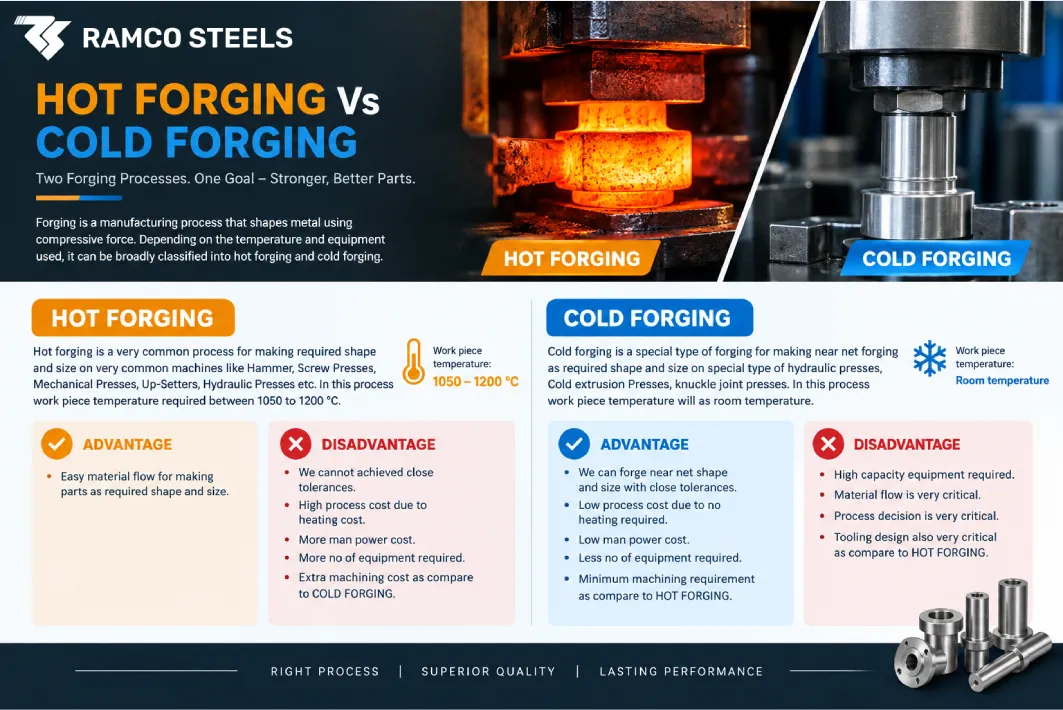
Hot forging is a manufacturing process in which metal is heated before being shaped using compressive force. For many steel forging applications, the workpiece temperature typically ranges between 1,050°C and 1,200°C.
Hot forging is performed using conventional machines such as hammers, screw presses, mechanical presses, up setters, and hydraulic presses. Heating the workpiece improves material flow, making it easier to achieve the required shape and size.
Cold forging is a specialized manufacturing process used to produce components close to their final shape and size. The workpiece is generally processed at room temperature using specialized equipment, including hydraulic presses, cold extrusion presses, and knuckle-joint presses.
Cold forging is particularly suitable for manufacturing components that require close dimensional tolerances, good surface finish, and minimal additional machining.
| S.no | Parameter | Hot Forging | Cold Forging |
|---|---|---|---|
| 1 | Working temperature | 1,050–1,200°C for many steel applications | Room temperature |
| 2 | Material flow | Easier due to heating | Requires careful control |
| 3 | Dimensional accuracy | Close tolerances can be challenging | Close tolerances are achievable |
| 4 | Heating cost | Required | Generally, not required |
| 5 | Machining | May require additional machining | Usually reduced |
| 6 | Equipment | Conventional forging machines and heating equipment | Specialized, often high-capacity presses |
| 7 | Tooling design | Important | Highly critical |
Both hot forging and cold forging offer distinct manufacturing benefits. Hot forging is suitable when easier material flow and substantial deformation are required, while cold forging is preferred when near-net-shape production, close tolerances, and reduced machining are priorities.
The right process depends on component design, material properties, production requirements, equipment capacity, and overall manufacturing costs. Evaluating these factors helps manufacturers achieve the desired quality and production efficiency.
Ramco Steels recognizes the importance of understanding manufacturing processes and material requirements to support informed industrial decisions.



Corporate Office
Plot No. 75, Sector 25,


